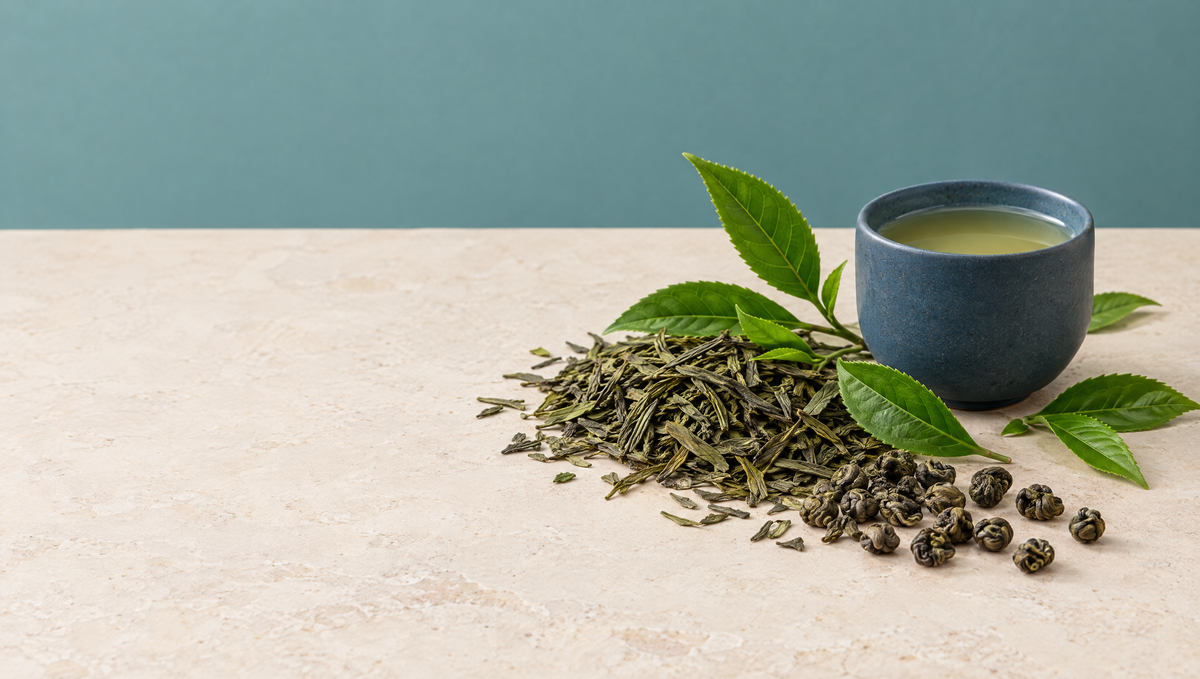
Every time sun reaches your skin, it creates unstable molecules that damage your cells, and the redness that follows can take days to settle. Green tea extract carries plant compounds called catechins that neutralize those molecules and calm that redness.

The short answer

Green tea extract is an antioxidant, which means an ingredient that neutralizes the unstable molecules sun creates in your skin. It also lowers the inflammatory signals behind redness. The protection starts with the first application, and calmer skin builds over about six weeks.

Coral UV rays creating jagged unstable molecules near skin cells, with teal catechin particles turning them into calm slate circles.
Catechins give up one of their own electrons to the unstable molecules sun creates, which stops them damaging your cells.

What it does

Green tea extract is an antioxidant, which means an ingredient that neutralizes the unstable molecules sun creates in your skin. It also lowers the inflammatory signals behind redness. The protection starts with the first application, and calmer skin builds over about six weeks.

Why sun and inflammation turn skin red

When UV light reaches your skin, it creates unstable molecules called free radicals. A free radical is missing an electron, and it takes one from the fats, proteins and DNA in your cells, damaging them. Your skin answers with inflammation, which widens blood vessels, and those widened vessels are the redness you see.

Inflammation is one of the root causes of aging skin, and it is why breakouts come up red and sore. Inflammation is also what can make rosacea look flushed.

How green tea works

Green tea leaves are rich in catechins, plant compounds that act as antioxidants. A catechin gives up one of its own electrons to a free radical, which settles that molecule before it can damage your cells. The most abundant and most studied catechin is epigallocatechin gallate, shortened to EGCG.

In laboratory studies, EGCG also lowers the inflammatory signals that stressed skin cells release. Your skin needs some oil, because it is part of your barrier, and oily skin makes more than it needs. In oil gland cells, EGCG lowered oil production and reduced the bacteria associated with acne.

Where green tea comes from

Green, white and black tea all come from the same plant, Camellia sinensis. For green tea, the fresh leaves are heated or steamed, which stops an enzyme in the leaf from oxidizing the catechins. White tea is withered and dried without that heating step. Black tea is left to oxidize, which turns much of its catechin content into other compounds.

Skincare uses an extract of the leaf, or EGCG purified from it. How many catechins an extract carries depends on the tea and on how the extract was made.

Two ingredient lists drawn as bars, one with a tea leaf icon near the top and one with the leaf icon near the bottom.
Ingredients are listed from the largest amount down. Green tea near the top is a main ingredient, and near the end a supporting one.

What the research shows

Sun and redness. In volunteers, green tea extract applied topically 30 minutes before UV light reduced the redness that followed, and more extract meant less redness. Those areas also showed fewer sunburn cells and less DNA damage.

On everyday facial redness, a 12-week study of 16 people found less redness by week six with a product combining green tea, caffeine and resveratrol. There was no comparison group, and the result cannot be credited to green tea alone.

Breakouts. In an eight-week split-face trial of 35 people, one percent EGCG reduced inflamed breakouts and blackheads and whiteheads more than the same cream without it. Smaller trials of a two percent tea lotion also found fewer inflamed breakouts. These trials are small, which is why we see green tea as a helpful addition for breakout-prone skin, not an ingredient that clears breakouts by itself.

Oil. In 22 men, a five percent green tea cream used nightly for 60 days lowered facial oil by about 27 percent compared with a placebo cream on the other cheek. The research on oily skin is small and only in men, and promising rather than settled.

What to look for on a label

Main ingredient or supporting ingredient

Many products include green tea in a small amount as a supporting antioxidant, which is a legitimate job. It is worth knowing which kind you have, because the studies above used one to five percent. Ingredients on a US label run from the largest amount to the smallest, and below one percent they can appear in any order. Green tea in the first third generally means a main ingredient. Near the end, among the preservatives, it is a supporting one.

Names on a label

Camellia Sinensis Leaf Extract, sometimes written Camellia Sinensis (Green Tea) Leaf Extract, is the whole leaf extract. White tea is listed under the same plant name. Epigallocatechin Gallate, or EGCG, means the main catechin has been purified and added on its own.

Where it sits in your routine

A green tea serum goes on after cleansing and before your moisturizer. If your green tea is in a moisturizer, that is your moisturizer step. Cleansers do a weaker version of what serums do, because they are rinsed off, which makes a green tea cleanser a small bonus.

What works best with green tea

Green tea does not exfoliate or change the pH of your skin, which means it does not compete with your other ingredients. Vitamin C and vitamin E are antioxidants too, and using them with green tea gives your skin more than one way to deal with free radicals. Niacinamide calms redness through a different route, by supporting your barrier.

Sunscreen every morning, reapplied through the day. Green tea reduces some of the damage UV does once it reaches your skin, and it does not stop UV from arriving.

Common questions

Will drinking green tea do the same thing?

It can help, and doing both is reasonable. Catechins taken by mouth do reach your skin. In a small study of 14 people, 12 weeks of daily catechins meant a little less redness after UV light, although a controlled trial of 50 people found no clear protection. Your body decides where catechins go, which means drinking does not deliver a predictable amount to your face. Applying green tea topically is how you control that amount.

Green tea as a drink is generally regarded as safe. Supplements at 800 milligrams of EGCG a day or more have raised liver enzymes in trials, which makes a supplement a question for your doctor.

Can green tea help with rosacea?

Yes, as part of a routine, although the research on rosacea is early. In four people with facial redness, a 2.5 percent EGCG cream used for six weeks lowered the signals that drive new blood vessel growth, without a measurable change in redness. Four people are too few to tell either way.

How soon will I see something?

The antioxidant protection works from the first application. In the studies, redness eased by about six weeks and oil by about two months. If breakouts are part of your reason, give your routine three to six months, because the congestion you see today began forming around 90 days earlier.

Is green tea safe in pregnancy?

Generally yes, applied topically. Green tea is not one of the ingredients usually avoided in pregnancy, although like most skincare ingredients, it has not been tested on pregnant people. Check with your OB or midwife before starting anything new.

A tea plant branch with arrows to three bowls of leaves: steamed bright green, pale silvery and dark twisted.
Green, white and black tea come from the same plant. Processing decides how many of the leaf catechins survive.

How to use it

  • Use green tea once or twice a day. There is nothing to build your tolerance up to with green tea.
  • On retinoid or exfoliating acid nights, apply the active first, onto clean skin, then green tea, then your moisturizer.
  • If oil is your main reason, choose a serum or moisturizer that lists green tea in the first third of the ingredients.
  • Photograph your skin on day one in natural daylight, in the same spot, then every four weeks.
  • Broad spectrum SPF 30 or higher every morning, reapplied through the day.
Evidence and sources
  • Elmets CA, Singh D, Tubesing K, Matsui M, Katiyar S, Mukhtar H. Cutaneous photoprotection from ultraviolet injury by green tea polyphenols. Journal of the American Academy of Dermatology, 2001;44(3):425-432. The study of green tea extract applied before UV exposure in volunteers. Read the study
  • Ferzli G, Patel M, Phrsai N, Brody N. Reduction of facial redness with resveratrol added to topical product containing green tea polyphenols and caffeine. Journal of Drugs in Dermatology, 2013;12(7):770-774. The 12-week study of 16 people, with no comparison group. Read the study
  • Yoon JY, Kwon HH, Min SU, Thiboutot DM, Suh DH. Epigallocatechin-3-gallate improves acne in humans by modulating intracellular molecular targets and inhibiting P. acnes. Journal of Investigative Dermatology, 2013;133(2):429-440. The eight-week split-face trial, plus the laboratory work on oil gland cells. Read the study
  • Saric S, Notay M, Sivamani RK. Green tea and other tea polyphenols: effects on sebum production and acne vulgaris. Antioxidants, 2017;6(1):2. Systematic review covering the two percent tea lotion trials and the oil studies. Read the review
  • Mahmood T, Akhtar N, Moldovan C. A comparison of the effects of topical green tea and lotus on facial sebum control in healthy humans. Hippokratia, 2013;17(1):64-67. The split-face study of 22 men. Read the study
  • Santo Domingo D, Camouse MM, Hsia AH, Matsui M, Maes D, Ward NL, Cooper KD, Baron ED. Anti-angiogenic effects of epigallocatechin-3-gallate in human skin. International Journal of Clinical and Experimental Pathology, 2010;3(7):705-709. The split-face study of four people with facial redness and visible blood vessels. Read the study
  • Rhodes LE, Darby G, Massey KA, Clarke KA, Dew TP, Farrar MD, Bennett S, Watson REB, Williamson G, Nicolaou A. Oral green tea catechin metabolites are incorporated into human skin and protect against UV radiation-induced cutaneous inflammation in association with reduced production of pro-inflammatory eicosanoid 12-hydroxyeicosatetraenoic acid. British Journal of Nutrition, 2013;110:891-900. The open study of oral catechins, 14 people completing. Read the study
  • Farrar MD, Nicolaou A, Clarke KA, et al. A randomized controlled trial of green tea catechins in protection against ultraviolet radiation-induced cutaneous inflammation. American Journal of Clinical Nutrition, 2015;102(3):608-615. The three-month controlled trial of 50 people. Read the study
  • EFSA Panel on Food Additives and Nutrient Sources added to Food. Scientific opinion on the safety of green tea catechins. EFSA Journal, 2018;16(4):5239. Source for the liver enzyme finding at 800 milligrams of EGCG a day or more from supplements. Read the opinion
  • Paiva L, Rego C, Lima E, Marcone M, Baptista J. Comparative analysis of the polyphenols, caffeine, and antioxidant activities of green tea, white tea, and flowers from Azorean Camellia sinensis varieties affected by different harvested and processing conditions. Antioxidants, 2021;10(2):183. Source for how green and white tea are processed and how their catechin and caffeine content varies. Read the study
  • Frasheri L, Schielein MC, Tizek L, Mikschl P, Biedermann T, Zink A. Great green tea ingredient? A narrative literature review on epigallocatechin gallate and its biophysical properties for topical use in dermatology. Phytotherapy Research, 2020;34(9):2170-2179. Source for the stability of EGCG in skincare. Read the review
  • Zink A, Traidl-Hoffmann C. Green tea in dermatology: myths and facts. Journal der Deutschen Dermatologischen Gesellschaft, 2015;13(8):768-775. Review of green tea and EGCG in skin research. Read the review
  • US Code of Federal Regulations, Title 21, Section 701.3: Designation of ingredients. Source for how ingredients are ordered on a US cosmetic label. Read the regulation

A note on the evidence. How catechins neutralize free radicals is well described, and the UV study is a real human result. The breakout and oil trials are small, and the oil studies were only in men. The facial redness studies are very small or combine green tea with other ingredients, and the two oral studies disagree with one another.

Products with Green Tea

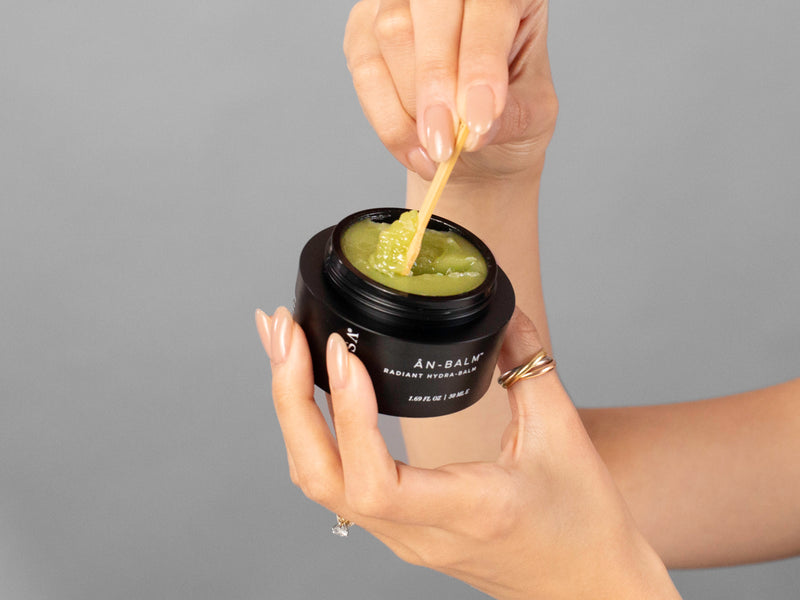
  • Anfisa

    Γ‚N-BALM

    4.8 out of 5.0 stars

    From $64.00

  • Face Reality

    Antioxidant Scrub

    4.9 out of 5.0 stars

    $34.00

  • GlyMed

    Beta Gel

    5.0 out of 5.0 stars

    $52.00

  • Alastin

    C-Radical Defense Antioxidant Serum

    4.8 out of 5.0 stars

    $218.00

  • Face Reality

    Clearderma Moisturizer

    4.8 out of 5.0 stars

    $33.00

  • Vivant

    Green Tea Antioxidant Cleanser

    4.5 out of 5.0 stars

    From $24.00

  • Hydrinity

    HYDRI-C Daily Vitamin C Moisturizer

    4.8 out of 5.0 stars

    From $20.00

  • Vivant

    Mandelic Acid 3-in-1 Wash

    5.0 out of 5.0 stars

    $26.00

  • GlyMed

    Radiant Serum

    5.0 out of 5.0 stars

    $85.00

  • Alastin

    Restorative Eye Complex

    4.9 out of 5.0 stars

    $128.00

  • GlyMed

    Revitalizing Essence

    4.8 out of 5.0 stars

    $50.00

  • Face Reality

    Soothing Radiance Toner

    5.0 out of 5.0 stars

    $32.00

  • Face Reality

    Ultra Gentle Gel Cleanser

    4.9 out of 5.0 stars

    From $14.00

  • iS Clinical

    Warming Honey Cleanser

    4.4 out of 5.0 stars

    $52.00

More Ingredient Guides

View all

German chamomile flowers beside a slate blue dish holding drops of clear, pale golden oil on a warm stone surface.

Bisabolol for Calming Redness and Irritation

Bisabolol is the calming compound first found in chamomile, and it quiets the inflammation behind redness, stinging and itch. Here is how it works, who it suits and how to use it.
Read moreabout Bisabolol for Calming Redness and Irritation

Fresh comfrey leaves and purple flowers beside a slate blue dish of fine white allantoin powder on a warm stone surface.

Allantoin for Rough, Dry and Irritated Skin

Allantoin softens rough, flaky skin and soothes irritation, and the US FDA recognizes it as a skin protectant. Here is how it works, what the research shows and how to use it.
Read moreabout Allantoin for Rough, Dry and Irritated Skin

Fresh centella sprigs with small round scalloped leaves on a warm stone surface beside a slate blue ceramic dish, against a soft blush backdrop.

Centella for Redness and Reactive Skin

Centella calms inflammation, helps skin hold on to water and supports repair after irritation. Here is what the research shows, what cica means on a label and how to use it.

Read moreabout Centella for Redness and Reactive Skin