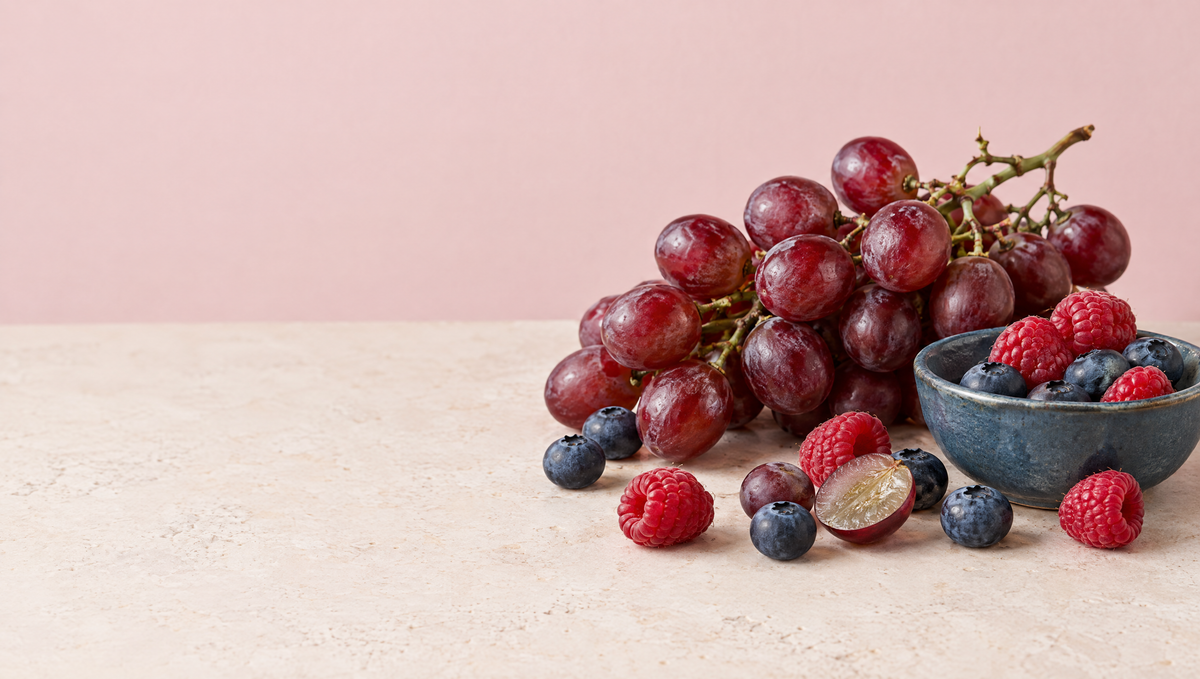
Many of the fine lines and much of the dullness you notice in your forties began years earlier, on ordinary days in the sun. Resveratrol, an antioxidant found in grapes and berries, helps protect your collagen and your glow from that daily damage.

The short answer

Resveratrol is an antioxidant, an ingredient that neutralizes the unstable molecules sun creates in your skin. It also calms the inflammation sun sets off, which helps you keep the collagen you have. In the small human studies, fine lines, tone and radiance improved with steady, daily use. Expect gradual, protective change rather than a quick one.

Diagram of light entering skin and forming jagged particles, which teal resveratrol molecules neutralize before they reach collagen.
Resveratrol gives up an electron to the unstable molecules sun creates, which stops them from damaging your collagen.

What it does

Resveratrol is an antioxidant, an ingredient that neutralizes the unstable molecules sun creates in your skin. It also calms the inflammation sun sets off, which helps you keep the collagen you have. In the small human studies, fine lines, tone and radiance improved with steady, daily use. Expect gradual, protective change rather than a quick one.

Why skin loses its collagen and its glow

Sun creates unstable molecules in your skin, often called free radicals, and pollution adds more. Each of these molecules is missing an electron and takes one from whatever is nearby, including your collagen, the protein that keeps skin smooth and springy.

Your skin makes its own antioxidants, and on a sunny day they can be outnumbered. The damage that gets through sets off inflammation, one of the root causes of aging skin. Inflammation switches on enzymes that break collagen down, which is how fine lines form. It can also prompt extra pigment and leave the surface uneven, and an uneven surface scatters light instead of reflecting it evenly, which is a large part of why skin looks dull.

How resveratrol works

Resveratrol works on that damage in two ways. It neutralizes unstable molecules directly, by giving up an electron of its own, which stops them taking one from your collagen. It also prompts your cells to make more of their own antioxidant enzymes, which means it strengthens the defenses your skin already has.

In human skin cells grown in a dish, resveratrol reduced the enzyme that breaks collagen down after UV exposure. In mice, resveratrol applied topically before UV reduced swelling, inflammation and oxidative damage.

There is a secondary benefit for tone. In laboratory work, resveratrol slows tyrosinase, the enzyme pigment cells use to make melanin. It works on excess pigment, not your natural skin tone.

Where resveratrol comes from

Plants make resveratrol to defend themselves against stress such as UV light and fungal infection. More than 70 plant species contain it, including grapes, berries, peanuts and a plant called Japanese knotweed, one of the most concentrated sources.

The resveratrol in skincare is extracted from plants such as Japanese knotweed or made through fermentation, and both routes give the same molecule.

Two panels: broken collagen fibers with coral particles and cutting enzymes, beside intact fibers protected by teal resveratrol molecules.
After sun, enzymes break collagen down. In skin cell research, resveratrol reduced that enzyme and helped keep the fibers intact.

What the research shows

The human evidence on resveratrol applied topically is small, and much of it comes from formulas that combine resveratrol with other antioxidants.

The largest study is a 2025 randomized, placebo-controlled trial in about 120 women over 40, who used a 1.5 percent resveratrol cream, a resveratrol supplement, both, or neither for eight weeks. Only the group using both saw wrinkles improve more than the placebo group did, and both groups using the cream saw pigmentation fade more than the placebo group did. The company that developed the ingredients funded it.

A smaller 12-week study of a night cream with 1 percent resveratrol, vitamin E and baicalin, another plant antioxidant, found improvements in fine lines, firmness, radiance and uneven pigment. Most of the researchers worked for the manufacturer, there was no placebo group, and part of the result belongs to the other two antioxidants.

What to look for on a label

The names it goes by

Look for resveratrol or trans-resveratrol, the form used in the studies. Those studies used 1 to 1.5 percent.

Why packaging matters

Resveratrol is sensitive to light. In one laboratory study, a cream lost about a third of its resveratrol under light that mimics the sun, and tiny capsules made of fats cut that loss to about a fifth. Opaque packaging and an encapsulated formula help keep it working.

Where it sits in your routine

Most resveratrol products are serums, which go on after cleansing and before your moisturizer. If yours is a cream, that is your moisturizer step.

What works best with resveratrol

Antioxidants work well as a team, because each antioxidant covers a different part of your skin. Vitamin C works in the watery parts and vitamin E in the oily parts, and the two protected skin from UV better together than either did alone. Ferulic acid, a plant antioxidant, makes vitamins C and E more stable, and in a study on pig skin it doubled the protection the pair gave. Resveratrol adds another antioxidant to that team.

Niacinamide works well alongside resveratrol, because it supports your barrier and evens tone, which are different jobs. A retinoid fits too: resveratrol helps protect the collagen you have, while a retinoid prompts your skin to build more.

Sunscreen every morning, reapplied through the day. Resveratrol neutralizes some of what UV creates in your skin, and it does not block UV, which means it works alongside sunscreen rather than in place of it.

Common questions

Can I get resveratrol from red wine?

No, not in an amount that would help your skin. Red wine contains about two milligrams of resveratrol per liter on average, while the supplement in the 2025 trial supplied 150 milligrams a day.

Does a resveratrol supplement help?

Yes, it can, based on the research available. Taken by mouth, resveratrol is well absorbed, though your body quickly converts most of it. In the 2025 trial, the group taking the supplement with the cream saw the clearest change in wrinkles.

A supplement cannot deliver a predictable amount to your skin, because your body distributes it by its own priorities. Applying resveratrol topically is how you control the amount on your face, and doing both is reasonable. Speak to your doctor before starting a supplement, especially if you take other medication.

Can I use it in the morning?

Yes. Many resveratrol products are designed for night because light breaks resveratrol down, and others are made to stay stable by day. Follow what the manufacturer recommends, and apply it before your sunscreen.

How soon will I see something?

The protection starts on day one, and you will not see that part. Changes in fine lines, tone and radiance were measured at eight to twelve weeks, which makes three months a fair trial. Photograph your skin on day one in natural daylight, in the same spot, then every four weeks. Week four is when many people decide nothing is happening, and it is the moment to keep going.

Is it safe in pregnancy?

Resveratrol has not been studied in pregnancy, and skincare ingredients are almost never tested on pregnant people. Vitamin C and niacinamide are generally considered safe in pregnancy, and most retinoids are avoided. Check with your OB or midwife before starting resveratrol or a resveratrol supplement.

Grapes, a Japanese knotweed stem and a flask of bubbling cells, each with its own arrow leading to one serum bottle.
Plants make resveratrol to defend themselves from stress. Skincare uses resveratrol extracted from plants or made by fermentation.

How to use it

  • Use resveratrol every day, once or twice a day as the manufacturer recommends. Using it consistently is what gives you results.
  • Apply it to clean, dry skin after cleansing, then follow with your moisturizer.
  • Close the cap straight after use and keep the product out of direct sunlight. Follow the storage directions on your packaging.
  • Broad spectrum SPF 30 or higher every morning, reapplied through the day.
  • Give it three months before you judge the result.
Evidence and sources
  • Rao A, Briskey D, Roche G, Tremblay A, Da Silva Pinto M, Tompkins TA. Trans-resveratrol reduces visible signs of skin ageing in healthy adult females over 40: an 8-week randomized placebo-controlled trial. Frontiers in Aging, 2025;6:1727244. The four-group trial of a 1.5 percent cream and a 75 mg twice-daily supplement; funded by the company that developed both, with authors employed by it and by the company that later acquired it. Read the study
  • Farris P, Yatskayer M, Chen N, Krol Y, Oresajo C. Evaluation of efficacy and tolerance of a nighttime topical antioxidant containing resveratrol, baicalin, and vitamin E for treatment of mild to moderately photodamaged skin. Journal of Drugs in Dermatology, 2014;13(12):1467-1472. The 12-week combination study; most authors were from the manufacturer. Read the study
  • Farris P, Krutmann J, Li YH, McDaniel D, Krol Y. Resveratrol: a unique antioxidant offering a multi-mechanistic approach for treating aging skin. Journal of Drugs in Dermatology, 2013;12(12):1389-1394. Review covering plant sources, its role in plants, and how resveratrol raises the skin's own antioxidant enzymes. Read the review
  • Na JI, Shin JW, Choi HR, Kwon SH, Park KC. Resveratrol as a multifunctional topical hypopigmenting agent. International Journal of Molecular Sciences, 2019;20(4):956. Review of how resveratrol slows tyrosinase directly and indirectly. Read the review
  • Lee J, Oh J, Song D, Lee M, Hahn D, Boo YC, Kang NJ. Acetylated resveratrol and oxyresveratrol suppress UVB-induced MMP-1 expression in human dermal fibroblasts. Antioxidants, 2021;10(8):1252. The skin cell research on the collagen-breaking enzyme. Read the study
  • Afaq F, Adhami VM, Ahmad N. Prevention of short-term ultraviolet B radiation-mediated damages by resveratrol in SKH-1 hairless mice. Toxicology and Applied Pharmacology, 2003;186(1):28-37. The mouse research on UV damage. Read the study
  • Scalia S, et al. Enhancement of trans-resveratrol photostability by encapsulation in lipid microparticles: in vitro and in vivo studies. Pharmazie, 2017;72(4). The laboratory study on light losses in a cream. Read the study
  • Lin JY, Selim MA, Shea CR, Grichnik JM, Omar MM, Monteiro-Riviere NA, Pinnell SR. UV photoprotection by combination topical antioxidants vitamin C and vitamin E. Journal of the American Academy of Dermatology, 2003;48(6):866-874. Pig skin study: the combination protected better than either vitamin alone. Read the study
  • Lin FH, Lin JY, Gupta RD, et al. Ferulic acid stabilizes a solution of vitamins C and E and doubles its photoprotection of skin. Journal of Investigative Dermatology, 2005;125(4):826-832. Pig skin study: adding ferulic acid stabilized vitamins C and E and roughly doubled their UV protection. Read the study
  • Walle T, Hsieh F, DeLegge MH, Oatis JE Jr, Walle UK. High absorption but very low bioavailability of oral resveratrol in humans. Drug Metabolism and Disposition, 2004;32(12):1377-1382. How the body absorbs and converts resveratrol taken by mouth. Read the study
  • Stervbo U, Vang O, Bonnesen C. A review of the content of the putative chemopreventive phytoalexin resveratrol in red wine. Food Chemistry, 2007;101(2):449-457. Source for the average resveratrol content of red wine.
  • Krutmann J, Liu W, Li L, et al. Pollution and skin: from epidemiological and mechanistic studies to clinical implications. Journal of Dermatological Science, 2014;76(3):163-168. How pollution adds to oxidative stress in skin. Read the review

A note on the evidence. The antioxidant activity of resveratrol is well established, and its effects on collagen, UV damage and the pigment enzyme come from cells and mice. In people, there is one developer-funded placebo-controlled trial and one small manufacturer-run study of a combination formula. Both found improvements, which is real and not the same as long-term, independent data.

Products with Resveratrol

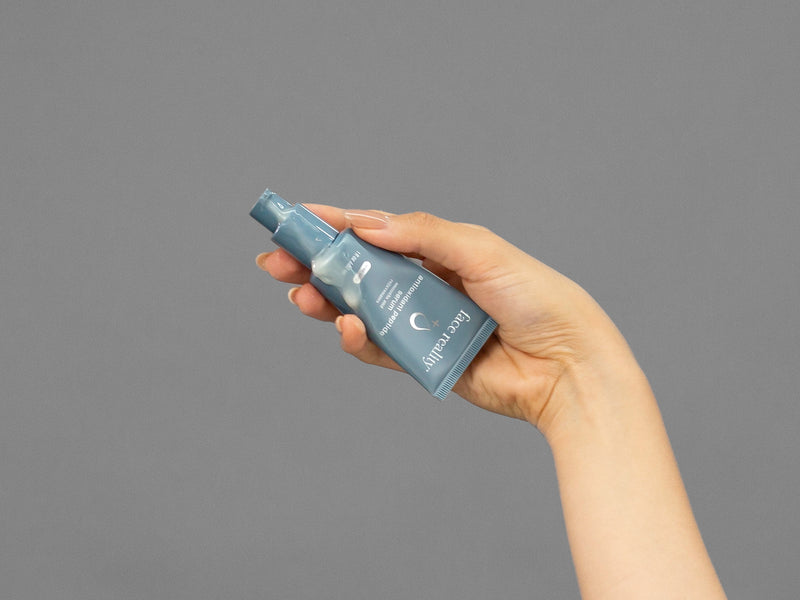
  • Face Reality

    Antioxidant Peptide Serum

    4.8 out of 5.0 stars

    $56.00

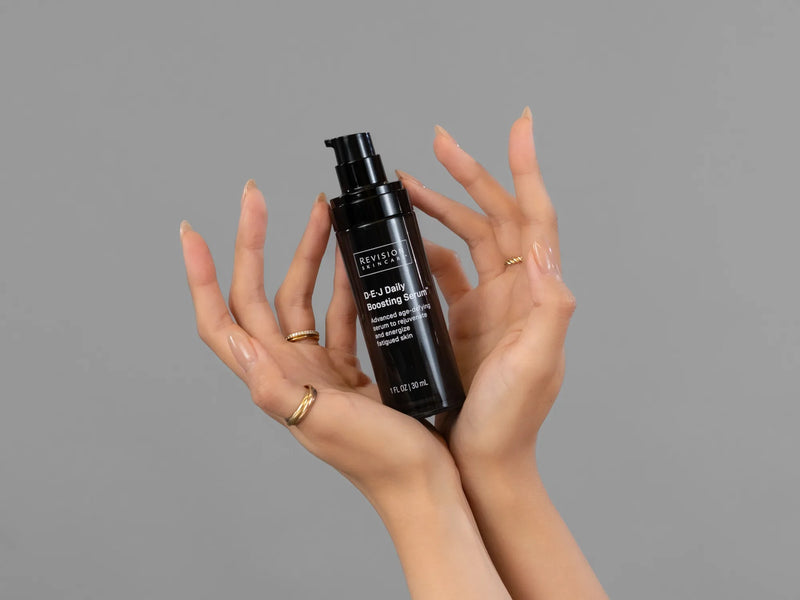
  • Revision

    From $140.00

  • Hale & Hush

    Hush Hydrate Gel

    5.0 out of 5.0 stars

    $40.00

  • Hale & Hush

    $98.00

  • Young Goose

    $196.50

  • Young Goose

    From $88.00

  • Young Goose

    From $109.00

More Ingredient Guides

View all

German chamomile flowers beside a slate blue dish holding drops of clear, pale golden oil on a warm stone surface.

Bisabolol for Calming Redness and Irritation

Bisabolol is the calming compound first found in chamomile, and it quiets the inflammation behind redness, stinging and itch. Here is how it works, who it suits and how to use it.
Read moreabout Bisabolol for Calming Redness and Irritation

Fresh comfrey leaves and purple flowers beside a slate blue dish of fine white allantoin powder on a warm stone surface.

Allantoin for Rough, Dry and Irritated Skin

Allantoin softens rough, flaky skin and soothes irritation, and the US FDA recognizes it as a skin protectant. Here is how it works, what the research shows and how to use it.
Read moreabout Allantoin for Rough, Dry and Irritated Skin

Fresh centella sprigs with small round scalloped leaves on a warm stone surface beside a slate blue ceramic dish, against a soft blush backdrop.

Centella for Redness and Reactive Skin

Centella calms inflammation, helps skin hold on to water and supports repair after irritation. Here is what the research shows, what cica means on a label and how to use it.

Read moreabout Centella for Redness and Reactive Skin