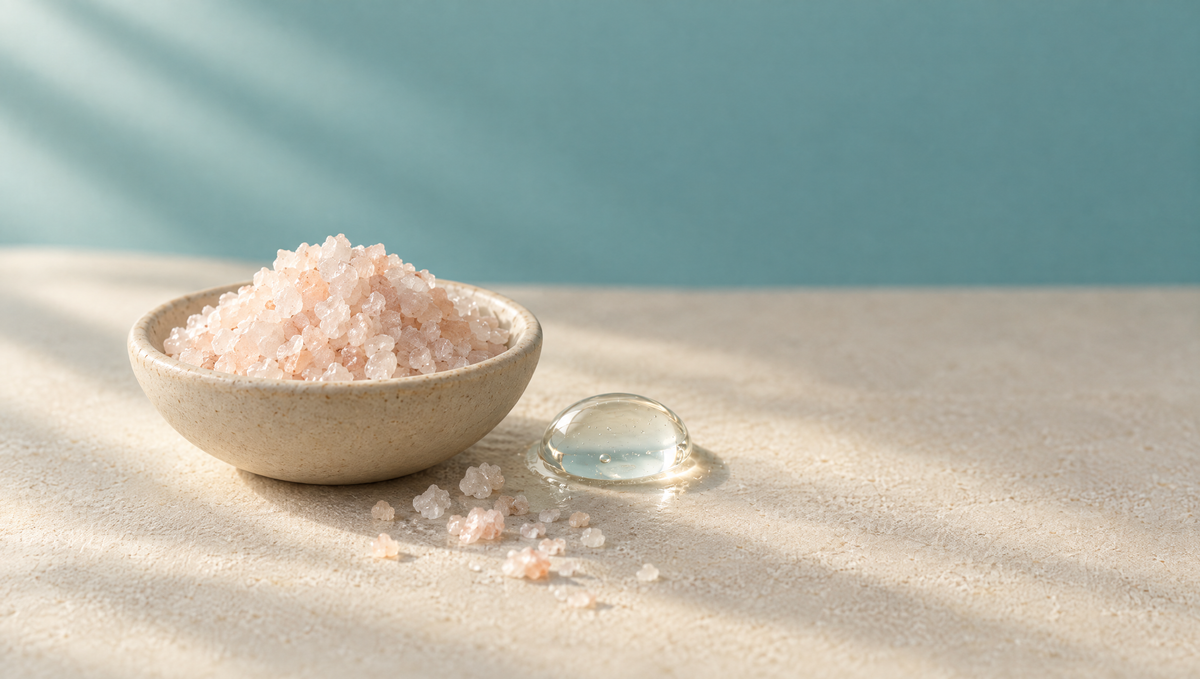
Ectoin comes from bacteria that live in desert salt lakes, where the water is saltier than the sea and the sun is relentless. They survive by making a molecule that holds their cells together under that kind of stress. Applied topically, it does something similar for skin that reacts to everything.

The short answer

Ectoin organizes water around the proteins and membranes in your skin cells, which holds them steady when heat, cold, pollution or dryness would otherwise disturb them. It is a protectant rather than a hydrator, and hydration improves as a result. Skin feels calmer within days and barrier measurements improve over about four weeks. It has clinical evidence behind it in eczema-prone skin and it is one of the gentlest things you can put on a reactive face.

Diagram of a protein wrapped in a dense ring of water droplets, with ectoin molecules held further out pushing the water in close.
Ectoin stays clear of your skin's proteins and pushes extra water in close around them, which keeps them in shape.

What it does

Ectoin organizes water around the proteins and membranes in your skin cells, which holds them steady when heat, cold, pollution or dryness would otherwise disturb them. It is a protectant rather than a hydrator, and hydration improves as a result. Skin feels calmer within days and barrier measurements improve over about four weeks. It has clinical evidence behind it in eczema-prone skin and it is one of the gentlest things you can put on a reactive face.

Why your skin reacts to the weather

Your skin cells are built from proteins, and proteins only work while they are folded into the right shape. That shape is held in place partly by the water sitting around them. It is a more fragile arrangement than it sounds.

Dry air pulls water out of your skin. Heat and cold disturb it. Pollution particles and harsh surfactants interfere with the fats holding your surface cells together. When that water layer is disrupted, proteins lose their shape and cell membranes stop behaving properly, and your skin responds with inflammation.

That is what is actually happening on the day your face is tight, red and stinging after a cold walk or a long flight. It is not that your skin has suddenly become weak. The conditions changed faster than it could adapt.

How ectoin works

Ectoin does something that no other common skincare ingredient does, and it is worth knowing, because it explains why it behaves differently from the hydrators you are used to.

Hyaluronic acid and glycerin are humectants, which means they attract water and hold onto it themselves. Ectoin does not do that. It works on the water that is already around your skin's proteins and cell membranes, organizing it into a stable shell that stays put.

The way it manages this is unusual. Ectoin is pushed away from the surface of a protein rather than sticking to it, and in being pushed away it forces extra water molecules in close around that protein instead. Researchers call this preferential exclusion. The practical result is a protein wrapped in a denser, better organized layer of water, which is far harder to dislodge.

So your proteins keep their shape and your cell membranes stay stable when the air turns dry or cold, and your skin has less reason to react in the first place.

This is why ectoin is described as a protectant rather than a moisturizer. Hydration does improve, and it improves because your skin is holding onto its own water better rather than because ectoin brought water with it.

Where ectoin comes from

It was found in bacteria living in desert salt lakes, in water several times saltier than the sea, under full sun. Conditions like that should pull a cell apart. The bacteria survive by manufacturing ectoin and filling themselves with it.

Compounds that let an organism survive extremes like this are called extremolytes. Ectoin is the best studied of them.

What goes into skincare is produced by fermenting those bacteria under controlled conditions, so a formula contains a known and consistent amount. Nothing is harvested from a lake.

It is worth knowing that ectoin has been used in medicine before skincare. It appears in nasal sprays for allergies and in eye drops for dryness, which tells you something about how well tolerated it is on delicate tissue.

Diagram comparing hyaluronic acid drawing scattered water toward a cell with ectoin keeping an orderly ring of water around it.
Hyaluronic acid draws water into your skin. Ectoin organizes the water already there, which is why the two work well together.

What the research shows

Ectoin has better clinical evidence than most people expect from an ingredient they have not heard of.

A double-blind controlled trial in adults with mild to moderate eczema measured an ectoin cream improving dryness, itch and severity scores. A later randomized trial in children aged two to eighteen compared a cream containing one percent ectoin and a small amount of hyaluronic acid against the same cream without them, and the ectoin group improved more over four weeks.

Laboratory work on skin cells shows ectoin protecting them from damage after UV exposure, and early research suggests effects on collagen that have not yet been tested on people. Treat that last part as promising rather than established.

A fair summary is that ectoin has real evidence for barrier, dryness and comfort, and that the anti-aging claims you will see attached to it are running ahead of what has been measured on human skin.

What to look for on a label

One to seven percent

The trials used creams somewhere between one and seven percent. One percent is enough to do useful work, and the higher concentrations were used on eczema-affected skin rather than for everyday maintenance.

Most brands do not state a figure. Position in the ingredient list tells you more, and ectoin appearing in the first third generally means it is there to work rather than to be named on the front of the box.

The names it goes by

On an ingredient list it appears as ectoin, sometimes spelled ectoine. Hydroxyectoin is a close relative that behaves similarly. All of these are the same family.

Where it sits in your routine

Most ectoin products are serums or light creams, which go on after cleansing and before your moisturizer. If yours is in a moisturizer, that is your moisturizer step.

What works best with ectoin

Ectoin conflicts with nothing. It pairs naturally with hyaluronic acid, since the two work on water from different directions: hyaluronic acid brings water in, ectoin keeps the water already there organized where your cells need it. Ceramides are the third part of that picture, filling the gaps in your barrier so less water escapes at all.

It is especially worth having on the nights you use a retinoid or an exfoliating acid, since those are the nights your barrier is under the most strain.

Sunscreen every morning, reapplied through the day. Ectoin reduces some of the damage UV does once it reaches your skin, and it does not block UV from arriving, so it works alongside your sunscreen rather than in place of it.

Common questions

Ectoin or hyaluronic acid?

Both, and they do different halves of the job. Hyaluronic acid draws water into your skin. Ectoin organizes the water that is already there so your cells can hold onto it when conditions turn against them.

If your skin is simply dehydrated, hyaluronic acid is enough on its own. If your skin is dehydrated and reacts to its surroundings, ectoin is the one that addresses the reacting.

Both are excellent at what they do, and plenty of good products contain the two together.

How soon will I see something?

Comfort arrives quickly, often within a few days, because the calming effect does not wait on your skin to rebuild anything.

The barrier improvements measured in the trials came over about four weeks. Keep going past the point where your skin feels better, because feeling better and being more resilient are not the same thing.

Will it help my eczema?

It helps with the dryness, the itch and the barrier weakness, and that is where the clinical evidence sits. Trials in both adults and children measured ectoin creams improving eczema severity scores against a control.

It works alongside whatever your doctor has given you rather than replacing it. If a doctor is managing your eczema, check with them before adding anything new.

Is it an antioxidant?

No, and the distinction is useful. An antioxidant such as vitamin C neutralizes the unstable molecules that damage your skin after they have formed. Ectoin works earlier, by holding your cell structures stable so there is less damage to deal with.

They are doing different jobs and both are worth having.

Can I use it on freshly treated skin?

Yes, and it is one of the most useful ingredients for it. Skin recovering from a peel or a laser is dealing with exactly the kind of stress ectoin was built to handle, and there is nothing in it to sting.

Follow whatever aftercare your provider has given you.

Is it safe in pregnancy?

There is no research on topical ectoin in pregnancy, which is true of most skincare ingredients since they are not tested on pregnant people. What we can tell you is that it is a compound used in nasal sprays and eye drops and is very well tolerated. Ask your OB or midwife and follow what they say.

Diagram showing a salt lake, a bacterium making ectoin, a fermentation flask and a serum bottle, in sequence.
Ectoin was discovered in bacteria from desert salt lakes. What goes into skincare is made by fermentation, so nothing is harvested from a lake.

How to use it

  • Morning and night. There is no irritation phase and nothing to build your tolerance up to with ectoin, so you can use it daily from the start.
  • Most ectoin products are serums or light creams, which go on after cleansing and before your moisturizer. If yours is a moisturizer, it takes the place of your usual one.
  • Apply to slightly damp skin and follow with a moisturizer. Ectoin keeps water organized where your cells need it, and something still has to stop that water leaving.
  • Use it on the nights you use a retinoid or an exfoliating acid, when your barrier is under the most strain.
  • Reach for it in the weeks when conditions change. Winter heating, summer air conditioning, a long flight, a move to a drier climate.
  • It is a good one to keep using on skin that is healing, including after in-clinic treatments, where there is nothing in it to sting.
  • Broad spectrum SPF 30 or higher every morning, reapplied through the day.
  • Give it four weeks for the barrier work, even though comfort arrives sooner.
Evidence and sources
  • Marini A, Reinelt K, Krutmann J, Bilstein A. Ectoine-containing cream in the treatment of mild to moderate atopic dermatitis: a randomised, comparator-controlled, intra-individual double-blind, multi-center trial. Skin Pharmacology and Physiology. The adult eczema trial described here.
  • Alexopoulos A, et al. A randomized, observer-blind, vehicle-control, multi-center clinical investigation of a 1% ectoine and 0.1% hyaluronic acid containing device in pediatric patients with mild-to-moderate atopic dermatitis. Pediatric Dermatology, 2023. The children's trial, 70 patients aged 2 to 18. Read the study
  • Czech L, et al. Role of the extremolytes ectoine and hydroxyectoine as stress protectants and nutrients. Genes, 2018. Covers the preferential exclusion mechanism described above. Read the review
  • Chen W, et al. Bioactivity profiling of the extremolyte ectoine as a promising protectant. Covers the hydration shell chemistry. Read the review

A note on the evidence. The mechanism is well described and the eczema trials are genuine randomized work, though they are small and short, and several were run by parties with a commercial interest in the ingredient. The laboratory findings on collagen and UV protection come from cell studies rather than from people, which is why this page treats barrier and comfort as the established benefits and leaves the rest as promising.

Products with Ectoin

  • Alastin

    C-Radical Defense Antioxidant Serum

    4.8 out of 5.0 stars

    $218.00

  • Alastin

    Hydratint Pro Mineral Sunscreen SPF 36

    4.9 out of 5.0 stars

    $84.00

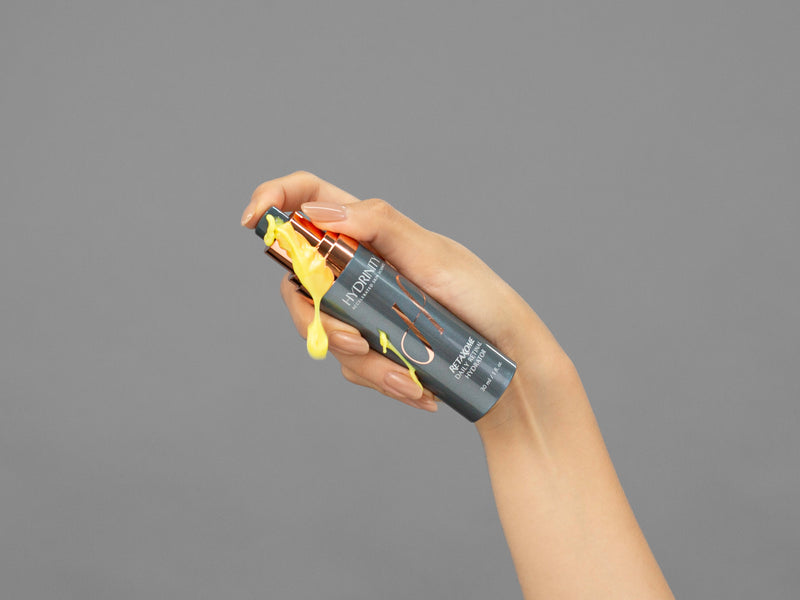
  • Hydrinity

    Retaxome Daily Retinal Hydrator

    5.0 out of 5.0 stars

    From $20.00

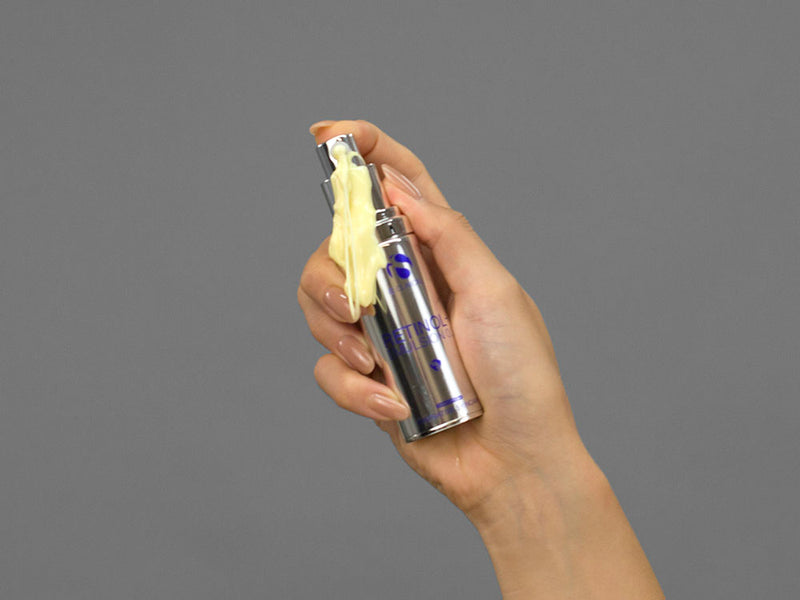
  • iS Clinical

    $117.00

  • SkinBetter Science

    Solo Hydrating Defense MEN

    5.0 out of 5.0 stars

    $180.00

  • Young Goose

    From $88.00

More Ingredient Guides

View all

German chamomile flowers beside a slate blue dish holding drops of clear, pale golden oil on a warm stone surface.

Bisabolol for Calming Redness and Irritation

Bisabolol is the calming compound first found in chamomile, and it quiets the inflammation behind redness, stinging and itch. Here is how it works, who it suits and how to use it.
Read moreabout Bisabolol for Calming Redness and Irritation

Fresh comfrey leaves and purple flowers beside a slate blue dish of fine white allantoin powder on a warm stone surface.

Allantoin for Rough, Dry and Irritated Skin

Allantoin softens rough, flaky skin and soothes irritation, and the US FDA recognizes it as a skin protectant. Here is how it works, what the research shows and how to use it.
Read moreabout Allantoin for Rough, Dry and Irritated Skin

Fresh centella sprigs with small round scalloped leaves on a warm stone surface beside a slate blue ceramic dish, against a soft blush backdrop.

Centella for Redness and Reactive Skin

Centella calms inflammation, helps skin hold on to water and supports repair after irritation. Here is what the research shows, what cica means on a label and how to use it.

Read moreabout Centella for Redness and Reactive Skin