5 min read

Mandelic acid does three jobs at once. It exfoliates, it reduces the bacteria involved in acne, and it works on pigment, which means one ingredient covering ground that usually takes three products. It is also the gentlest of the exfoliating acids, which is what makes that combination so useful.

The short answer

Mandelic acid clears dead cells like any AHA, and alongside that it reduces acne bacteria and works on pigment. Being the largest AHA molecule, it enters the skin slowly and evenly and rarely stings. That combination makes it a strong choice for acne-prone skin that also marks easily, and for anyone whose skin has never got on with exfoliation.

Suits All skin types, Sensitive, Acne-prone, Rosacea-prone, Oily, Combination
Read time 5 min
Diagram showing mandelic acid doing three things at once: exfoliating, reducing acne bacteria and working on pigment.
One ingredient covering ground that usually takes three products.

What it does

Mandelic acid clears dead cells like any AHA, and alongside that it reduces acne bacteria and works on pigment. Being the largest AHA molecule, it enters the skin slowly and evenly and rarely stings. That combination makes it a strong choice for acne-prone skin that also marks easily, and for anyone whose skin has never got on with exfoliation.

What exfoliating acids do

Your skin replaces itself constantly, and the dead cells at the surface are held on by bonds that behave like glue. When shedding slows, those cells linger, sitting unevenly and scattering light rather than reflecting it. That is what dullness and rough texture are.

An exfoliating acid dissolves that glue so the dull layer lifts away. Mandelic acid does this, and what is unusual is how much else it is doing at the same time.

The other two jobs

It works on excess pigment

All exfoliating acids brighten to some degree, simply because turning skin over faster carries pigmented cells up and away.

Mandelic acid does that, and there is evidence it also slows tyrosinase, the enzyme that manufactures pigment, which is the same target arbutin and kojic acid work on. So it clears the pigment already there while reducing the new pigment forming behind it.

To be clear about what that means: it acts on pigment cells that are overproducing in response to sun, heat, inflammation or hormones. Your natural skin tone is genetic and is not affected. The goal is evenness rather than lightness.

It reduces acne bacteria

This is unusual for an exfoliating acid and is why mandelic turns up so often in acne ranges. It also mixes with oil more readily than glycolic or lactic acid, so it gets into an oily pore more comfortably than you would expect.

Why it is so gentle

Mandelic acid is the largest of the common exfoliating acid molecules. Being large means it enters the skin slowly and uniformly rather than all at once, and that even entry is the main reason it so rarely stings.

It matters most on deeper skin. Aggressive exfoliation and the dryness that follows it can genuinely cause problems on deeper skin tones, because both trigger excess pigment, and you can end up with a fresh mark where you were working on an old one.

Whatever acid you choose, going slowly and keeping your skin comfortable is not fussiness. It is how you avoid making the original problem worse.

Where mandelic acid comes from

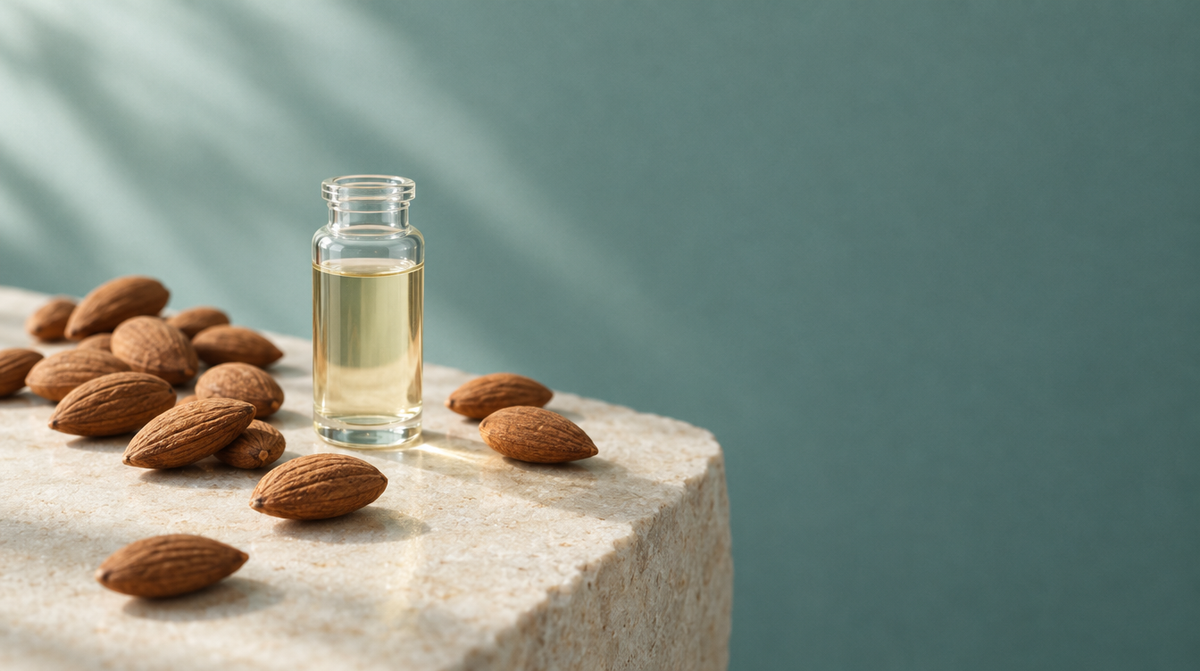
It comes from bitter almonds, and the name follows from that, since Mandel is German for almond. It was first isolated in the nineteenth century and used in medicine as a urinary antiseptic long before anyone put it on a face, which is a hint about the antibacterial side of it.

Most mandelic acid in skincare is produced synthetically rather than pressed from almonds, though not every brand works the same way. If you have a nut allergy, check the source with the manufacturer before using it, and patch test on your inner arm regardless.

Diagram comparing a small molecule entering skin rapidly and unevenly with a large molecule entering slowly and evenly without irritation.
Being the largest molecule means slow, even entry, and that is the main reason mandelic acid so rarely stings.

What to look for on a label

Five to eight percent on the face

Five percent is where to start and eight percent is about as far as most faces need to go. Ten to fifteen percent products exist, and those are generally intended for the body, where the skin is thicker and more forgiving. Ten percent on the face is stronger than most people need.

Start low and stay there while it is working. Only consider moving up if you have gone three weeks or more without seeing any further change, and even then it is worth asking whether frequency or consistency is the thing to adjust first.

pH matters as much as percentage

An acid only exfoliates in its acidic form, and how much of it is in that form depends on the pH of the formula. Eight percent at pH 3.5 does noticeably more than eight percent at pH 5. You will rarely be told the pH, which is why the number on the front tells you less than people assume.

Format changes everything

A mandelic wash does a weaker version of what a serum does, since it is on your skin for under a minute, and that makes it a gentle way in. A toner sits longer. A serum works for hours and does the most. Plenty of people use a wash daily and a serum a few nights a week, which is an easy way to build up.

Where it sits in your routine

A mandelic serum or toner goes on clean, dry skin before your moisturizer. If yours is a wash, use it at the cleansing step as you normally would.

What works best with mandelic acid

Mandelic acid pairs well with the other pigment ingredients, so adding arbutin, kojic or azelaic acid gives you several angles on the same problem. Niacinamide is a natural partner for post-breakout marks.

With a retinoid, keep them on separate nights unless your product is formulated as a two in one.

Sunscreen every morning, reapplied through the day. This one is not a general reminder: sun exposure darkens the exact marks you are using mandelic acid to fade, so skipping it means undoing your own work as you go.

Common questions

Is it a good choice for deeper skin tones?

Yes. It is a good option, particularly if you are dealing with acne and pigmentation together.

Deeper skin pigments much easier, and aggressive exfoliation that causes dryness can make pigmentation worse, which is why mandelic acid is a great choice for acne-prone, deeper skin tones. It enters the skin slowly and evenly, so it clears texture and works on marks without the irritation that would set off more pigment.

If pigment is your only concern, gentler pigment ingredients are worth looking at as well. Arbutin and azelaic acid do not exfoliate at all, which is an advantage when you want to work on marks without disturbing the surface.

I have a nut allergy. Can I use it?

Check the source with the manufacturer before you do. Mandelic acid is usually produced synthetically and contains no almond protein, which is what an allergy responds to, and production methods vary between brands, so we would rather you asked than assumed. Patch test on your inner arm either way.

Will it help my breakouts as well as the marks?

Yes, and that is what makes it so useful when both are happening. It reduces acne bacteria, keeps pores clearer, and works on the marks left behind.

For heavier congestion, salicylic acid gets further inside the pore, so the two are worth combining.

Will it lighten my natural skin tone?

No. It works on pigment cells that are overproducing in response to sun, heat, inflammation or hormones. Your natural tone is genetic and mandelic acid does not affect it. What you are aiming for is evenness.

How soon will I see something?

Smoothness and brightness within three to four weeks. Excess pigment takes eight to twelve, as it always does.

Photograph your skin on day one and every four weeks after, in the same spot and the same light, because fading is nearly impossible to judge in the mirror.

Is it safe in pregnancy?

Mandelic acid is generally considered one of the acceptable options during pregnancy, and its gentleness makes it a good one to turn to when a lot of things have come off the table. Check with your OB or midwife before starting anything new.

Three-stage diagram showing aggressive exfoliation leading to irritation and dryness, which leads to a new dark mark on deeper skin.
On deeper skin you can end up with a fresh mark where you were working on an old one. Going slowly is how you avoid that.

How to use it

  • How often depends on the strength of your product, so follow what the manufacturer recommends. If you are not sure, twice a week is a safe place to start.
  • Most people build to three or four times a week. A wash can be used daily.
  • Use it at night if your evenings are otherwise free of actives. If you are already using a retinoid or benzoyl peroxide at night, put your mandelic acid in the morning instead and follow with sunscreen.
  • Start at five percent and stay there while you are still seeing progress. Only move up if three weeks or more have passed with no further change.
  • Apply it across the whole area rather than onto individual marks. Excess pigment you cannot see yet is already forming, and spot application leaves you with a patchwork.
  • Follow with a hydrating serum and moisturizer. Keeping your skin comfortable matters especially on deeper tones, where dryness can bring on excess pigment of its own.
  • Broad spectrum SPF 30 or higher every morning, reapplied through the day. Sun exposure darkens the marks you are working on, so this is doing as much for your result as the acid is.
  • Pause around waxing, threading, laser and in-clinic treatments, usually four to seven days either side. Ask whoever is doing the treatment.
  • Photograph your skin on day one, then every four weeks, and give excess pigment twelve weeks before you judge it.
Evidence and sources

A note on the evidence. Mandelic acid is less studied than glycolic or lactic acid, which is worth saying plainly. Its antibacterial properties are well established from its long medical use, and its effect on tyrosinase has been demonstrated, so the mechanisms behind the claims here are sound. The clinical work on mandelic acid in acne and pigmentation is real but consists mostly of smaller studies, often testing it inside combination peels rather than on its own. Its reputation for suiting deeper skin tones rests on that gentleness and even penetration, and on a good deal of clinical experience, more than on large comparative trials.

Last reviewed

Products with Mandelic Acid (AHA)

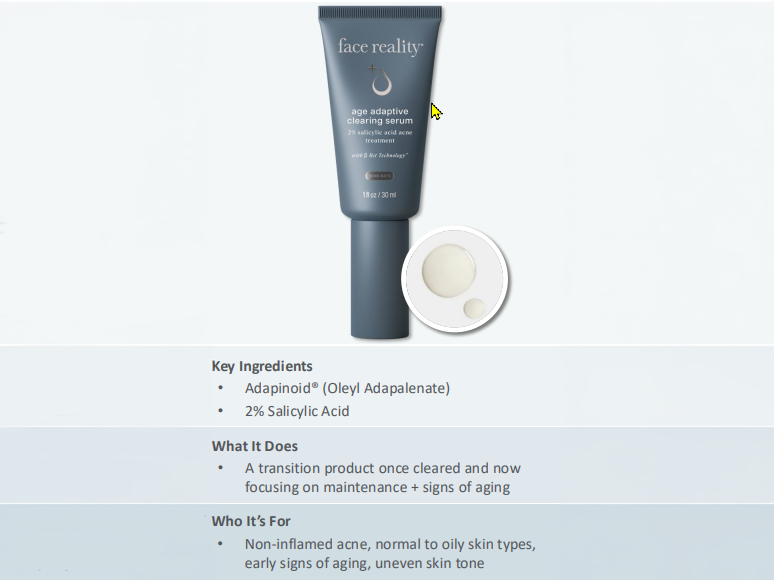
  • Face Reality

    Age Adaptive Clearing Serum

    4.0 out of 5.0 stars

    $76.00

  • Hale & Hush

    From $26.00

  • Vivant

    $86.00

  • Vivant

    $220.00

  • Vivant

    $294.00

  • Vivant

    $226.00

  • GlyMed

    Idyllic Cleanser

    4.9 out of 5.0 stars

    From $10.00

  • Vivant

    Mandelic Acid 3-in-1 Toner

    4.0 out of 5.0 stars

    From $66.00

  • Vivant

    Mandelic Acid 3-in-1 Wash

    5.0 out of 5.0 stars

    $26.00

  • Vivant

    Mandelic Acid Serum

    5.0 out of 5.0 stars

    From $84.00

  • Face Reality

    Mandelic Face & Body Scrub

    4.9 out of 5.0 stars

    $38.00

  • Face Reality

    Mandelic Face & Body Wash

    4.9 out of 5.0 stars

    $37.00

  • Face Reality

    Mandelic Serum

    4.9 out of 5.0 stars

    From $42.00

  • Marini SkinSolutions

    $103.00

  • GlyMed

    Radiant Serum

    5.0 out of 5.0 stars

    $85.00

  • Hale & Hush

    $52.00

  • Vivant

    $304.00

  • Vivant

    Skin Nourishing Toner

    5.0 out of 5.0 stars

    $72.00

More Ingredient Guides

View all

German chamomile flowers beside a slate blue dish holding drops of clear, pale golden oil on a warm stone surface.

Bisabolol for Calming Redness and Irritation

Bisabolol is the calming compound first found in chamomile, and it quiets the inflammation behind redness, stinging and itch. Here is how it works, who it suits and how to use it.
Read moreabout Bisabolol for Calming Redness and Irritation

Fresh comfrey leaves and purple flowers beside a slate blue dish of fine white allantoin powder on a warm stone surface.

Allantoin for Rough, Dry and Irritated Skin

Allantoin softens rough, flaky skin and soothes irritation, and the US FDA recognizes it as a skin protectant. Here is how it works, what the research shows and how to use it.
Read moreabout Allantoin for Rough, Dry and Irritated Skin

Fresh centella sprigs with small round scalloped leaves on a warm stone surface beside a slate blue ceramic dish, against a soft blush backdrop.

Centella for Redness and Reactive Skin

Centella calms inflammation, helps skin hold on to water and supports repair after irritation. Here is what the research shows, what cica means on a label and how to use it.

Read moreabout Centella for Redness and Reactive Skin