5 min read

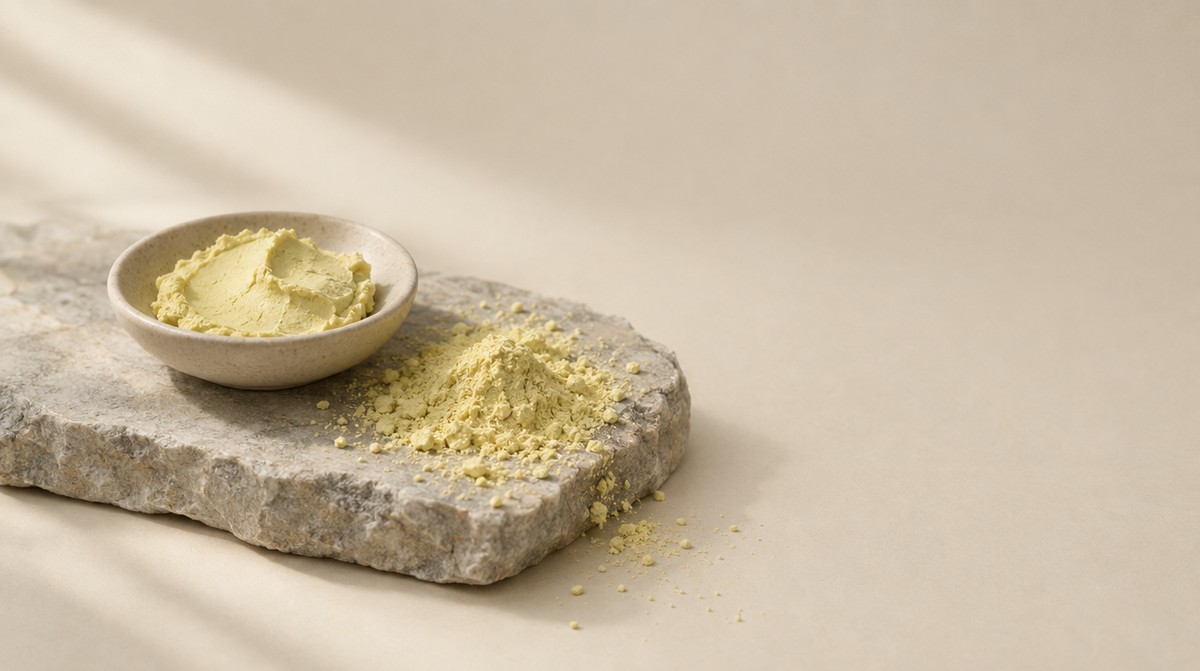
Sulfur is one of the oldest acne treatments there is, and it has stayed in use because it works on skin that cannot handle the other strong options. It helps a breakout decongest and settle down, absorbs excess oil and calms the redness, so the spot heals faster rather than lingering.

The short answer

Sulfur helps a breakout clear from the inside out. It loosens the plug of dead cells blocking the pore, soaks up the excess oil around it, reduces acne bacteria and calms the inflammation making it red. Spots settle within a day or two, and oiliness and congestion improve over a few weeks. It is gentle enough for rosacea-prone skin and considered safe in pregnancy, which makes it genuinely useful when the stronger acne ingredients are not an option.

Suits Oily, Combination, Acne-prone, Rosacea-prone, Sensitive
Read time 5 min
Diagram showing sulfur doing four things at once: loosening the plug, absorbing oil, reducing bacteria and calming redness.
A breakout involves four separate problems. Sulfur addresses all of them, and none aggressively.

What it does

Sulfur helps a breakout clear from the inside out. It loosens the plug of dead cells blocking the pore, soaks up the excess oil around it, reduces acne bacteria and calms the inflammation making it red. Spots settle within a day or two, and oiliness and congestion improve over a few weeks. It is gentle enough for rosacea-prone skin and considered safe in pregnancy, which makes it genuinely useful when the stronger acne ingredients are not an option.

What a breakout involves

A breakout starts with a blocked pore. Dead skin cells and oil build up inside it and form a plug, bacteria multiply in the sealed space that creates, and your immune system responds. The redness and soreness you can see is that response.

So there are four things going on at once: the plug, the excess oil, the bacteria and the inflammation. Most acne ingredients do not tackle them all at once.

How sulfur works

Sulfur addresses all four, and none of them aggressively.

It loosens the plug. Sulfur breaks up the bundle of dead skin cells blocking the pore so the pore can clear itself. Gentler than salicylic acid, working in the same direction.

It absorbs excess oil. Sulfur is a fine powder, and it soaks up the oil sitting on and around a breakout. That is why skin looks less shiny within minutes and why a sulfur mask is so satisfying on an oily day.

It reduces the bacteria involved in acne, which is part of why a spot stops progressing once you put it on.

And it calms inflammation, so the spot comes down and loses its redness rather than sitting there angry for a week.

Put together, that is a breakout being helped to resolve rather than being attacked. The point is a faster, calmer recovery, not stripping your skin.

Why it suits skin prone to redness

This is the part that makes sulfur worth knowing about, and it is unusual for an acne ingredient.

Skin prone to rosacea flushes at the slightest provocation, so the usual acne ingredients tend to make things worse even when they clear the spots. Sulfur reduces inflammation rather than causing it, so it works on the papules and pustules of rosacea without triggering the redness underneath.

There may be a second reason, though the evidence here is thinner and worth taking as such. Everyone has microscopic mites living in their skin, and they are found in greater numbers on rosacea-prone faces, which has led researchers to suggest they play a part in the condition. Some studies have measured sulfur reducing those numbers. Whether that is why it helps is not settled, and the anti-inflammatory effect is the better established explanation.

What is not in doubt is the history. The first sulfur formulation for rosacea was described in 1855, and it has been in continuous use since.

Where sulfur comes from

Sulfur is a mineral, mined from the ground, and it is one of the elements your own body needs. Your skin, hair and nails are built from proteins that contain it, so it is already part of you.

It has been used on skin for thousands of years, in hot springs and sulfur baths long before anyone understood why it helped. The version in skincare is purified and milled very fine so it spreads evenly.

Three-stage diagram showing a sulfur treatment used too often causing irritation around the spot, which leaves a brown mark where the spot was.
Overdoing it can leave you with exactly the marks you were trying to avoid.

What to look for on a label

Three to ten percent

Ten percent is the ceiling the FDA sets for sulfur in over-the-counter acne products. That figure comes from where the balance sits: above it you are not getting better clearing, you are taking more moisture out of your skin than the result is worth.

Higher is not better here, and the right number depends on where the product is going.

Spot treatment or mask

The difference is concentration, and it follows from the job. A spot treatment is stronger, usually five to ten percent, because it is going on one breakout and needs to work on it properly. That concentration on your whole face would be far more than you need.

A mask is lighter, because it is there for oiliness and general congestion across a wider area rather than for a single spot. Plenty of people keep both, for the two different jobs.

The smell is real

Sulfur smells like sulfur. Good formulas mask it well and it fades as the product dries, and no one has eliminated it entirely. It is worth knowing before you open the jar rather than after, and it is the main reason people use it at night.

Where it sits in your routine

A sulfur spot treatment goes on after your hydrating serum and before your moisturizer. A sulfur mask is a separate step, rinsed off, so it does not need a place in your daily order.

What works best with sulfur

Niacinamide is a natural partner, calming redness and regulating oil alongside it. Hyaluronic acid and ceramides are worth having in the routine to keep your skin comfortable while it works.

Avoid layering sulfur with a retinoid, benzoyl peroxide or other strong actives in the same routine. Use them on different nights instead.

Sunscreen every morning, reapplied through the day. Sun exposure darkens the brown marks a breakout leaves behind and makes them much slower to fade, so protecting the area is part of looking after it.

Common questions

Sulfur or benzoyl peroxide?

They work in broadly similar ways, and the difference is in what each one asks of your skin. Benzoyl peroxide is stronger on inflamed acne and clears it faster, and it is also more drying, which is why using it repeatedly on the same spot leaves some people irritated.

Sulfur is lighter and still effective. It suits rosacea-prone skin, it is an option in pregnancy, and it is the one to choose when your routine already contains something active. If you are using mandelic or salicylic acid and do not want to add benzoyl peroxide on top of them, sulfur gives you similar help with far less strain.

Both are excellent at what they do, and which suits you depends on how much your skin can take.

How quickly does it work?

A spot treated overnight is usually smaller and less red by morning, and mostly gone within a couple of days.

Regular mask use brings oiliness down within a few weeks. Getting fewer breakouts in the first place takes longer, because there is roughly ninety days of congestion already sitting in your skin at any time. You have to work through that before the rate of new spots drops.

Will it dry me out?

That depends on the concentration, on how much of your face you are covering, and on what else is in your routine. A five percent mask across your T-zone once a week is a very different proposition from a ten percent spot treatment used nightly alongside a retinoid.

A well-made sulfur formula pairs it with hydrating and soothing ingredients, which keeps the drying to a minimum.

Can I use it in pregnancy?

Sulfur is generally considered one of the acceptable acne options during pregnancy, alongside azelaic acid, and it is commonly recommended when retinoids and the stronger acne ingredients are off the table. Check with your OB or midwife before starting anything new.

Does it help with the marks left behind?

Indirectly. Those brown marks come from inflammation, so calming a spot faster means less of a post-breakout mark forming in the first place.

There is a flip side worth knowing. Overdoing a drying product irritates the skin around the spot, and irritation is itself a trigger for excess pigment. So using sulfur more often than you need can leave you with exactly the marks you were trying to avoid. Use it on the spots that need it, keep your moisturizing up, and you get the benefit without that risk.

For marks already there, a pigment ingredient such as azelaic, arbutin or kojic acid is what fades them.

Is it safe on deeper skin tones?

Yes, and the gentleness is an advantage. Deeper skin pigments much easier, and irritation is one of the things that triggers it, so an acne ingredient that calms rather than provokes is the safer route. Keeping the area well moisturized matters here, since dryness can bring on excess pigment of its own.

Four-step layering order for a sulfur spot treatment: hydrating serum, let it absorb, sulfur on the spot, then moisturizer over the top.
Putting it straight onto bare skin is the version that leaves you flaky. Order matters more than people expect.

How to use it

For a spot treatment, the order matters more than people expect. Putting it straight onto bare skin is the version that leaves you flaky.

  • Cleanse, then apply your hydrating serum and let it absorb properly.
  • Apply a small amount of the sulfur treatment directly onto the breakout and let that dry down too.
  • Then moisturizer over the top. Hydration underneath and moisturizer above means the sulfur works on the spot rather than on the skin around it.
  • Leave it on overnight, and rinse in the morning if the product says to.

For a mask, and for the rest of your routine:

  • Once or twice a week across the areas that get oily or congested, and follow the timing on the packaging. That timing depends on the percentage of sulfur and what else is in the formula, so it is specific to the product rather than a general rule.
  • Do not leave it on longer than directed hoping for more. Spot treatments and masks contain different concentrations of sulfur and are meant to stay on for different lengths of time, so the instructions on your product are the ones to follow. Overdoing it can actually make oiliness worse, because skin stripped of moisture often responds by producing more oil.
  • Night is easiest, mostly because of the smell.
  • Avoid layering sulfur with a retinoid, benzoyl peroxide or other strong actives. Use them on different nights.
  • Broad spectrum SPF 30 or higher every morning, reapplied through the day.
  • If you want to track whether your skin is improving, photograph it on day one and every four weeks after, in the same spot and the same light.
Evidence and sources

A note on the evidence. Sulfur has one of the longest track records in dermatology, used for acne, rosacea and skin infections for well over a century, and it remains an approved over-the-counter acne ingredient. Its oil-absorbing, mildly keratolytic and anti-inflammatory actions are well established, and its use in rosacea is long-standing clinical practice. Where the research is thinner is in head-to-head comparisons against the newer acne ingredients, since most of the trial work in that area has gone into benzoyl peroxide, retinoids and antibiotics. Sulfur is a well-understood ingredient that has simply been studied less recently than its competitors.

Last reviewed

Products with Sulfur

  • GlyMed

    Mattifying Sulfur Masque

    4.8 out of 5.0 stars

    $50.00

  • GlyMed

    Skin Resurfacing Lotion

    5.0 out of 5.0 stars

    $36.00

  • Face Reality

    Sulfur Spot Treatment

    4.8 out of 5.0 stars

    $35.00

More Ingredient Guides

View all

German chamomile flowers beside a slate blue dish holding drops of clear, pale golden oil on a warm stone surface.

Bisabolol for Calming Redness and Irritation

Bisabolol is the calming compound first found in chamomile, and it quiets the inflammation behind redness, stinging and itch. Here is how it works, who it suits and how to use it.

Read moreabout Bisabolol for Calming Redness and Irritation

Fresh comfrey leaves and purple flowers beside a slate blue dish of fine white allantoin powder on a warm stone surface.

Allantoin for Rough, Dry and Irritated Skin

Allantoin softens rough, flaky skin and soothes irritation, and the US FDA recognizes it as a skin protectant. Here is how it works, what the research shows and how to use it.

Read moreabout Allantoin for Rough, Dry and Irritated Skin

Fresh centella sprigs with small round scalloped leaves on a warm stone surface beside a slate blue ceramic dish, against a soft blush backdrop.

Centella for Redness and Reactive Skin

Centella calms inflammation, helps skin hold on to water and supports repair after irritation. Here is what the research shows, what cica means on a label and how to use it.

Read moreabout Centella for Redness and Reactive Skin